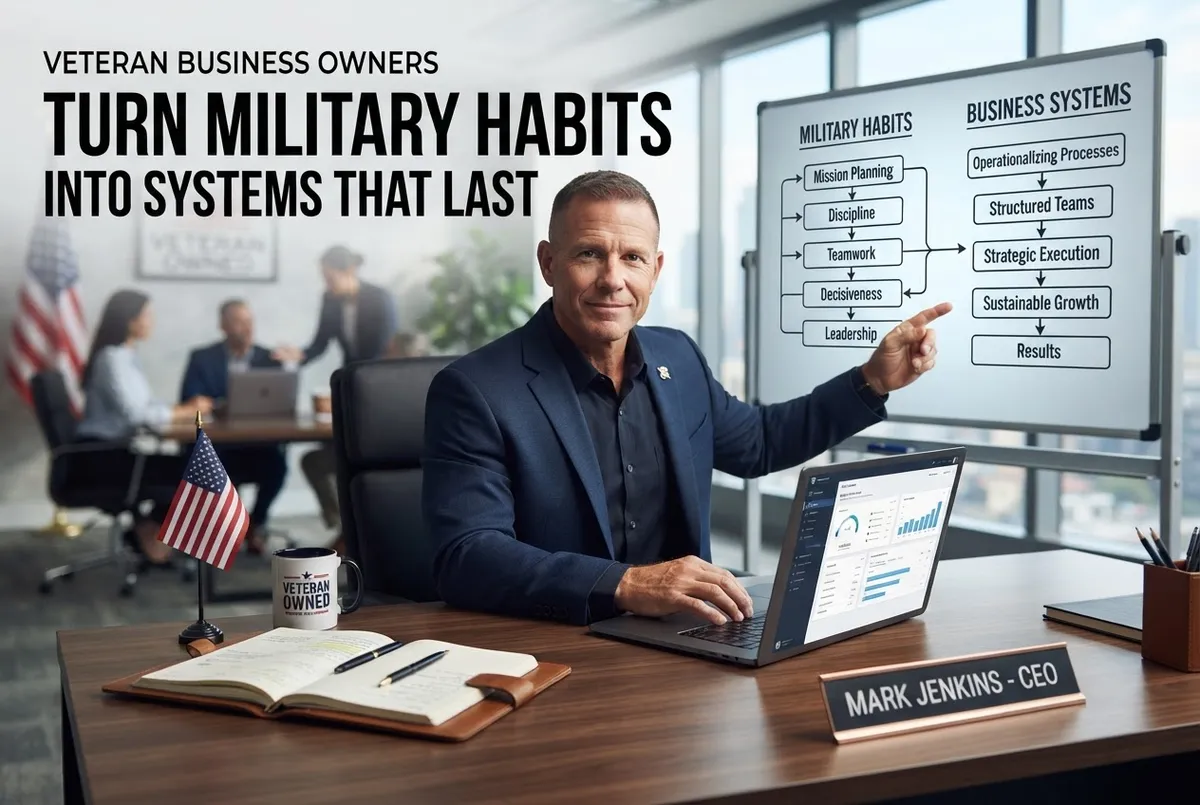
Veteran Business Owners: Turn Military Habits Into Systems That Last
Veteran Business Owners: Turn Military Habits Into Systems That Last
By Jason McNamara, U.S. Navy veteran and founder of The No More 9 to 5 Foundation
Published Thursday, October 29, 2026
The mission did not end when you took off the uniform.
You already know how to do hard things. Show up early, stay calm, and finish the job. What most of us lose when we transition out is the unit.
Veteran business owners rarely fail for lack of discipline. They burn out because they try to run every single piece alone.
The fix is what already worked in uniform. Written procedures, clear intent, regular inspection, and one owner for every task. Write it down, hand it off, and get back around people who have your six.
Why Veteran Entrepreneurs Burn Out
Most veteran owners burn out because they operate in isolation, not because they lack drive.
The numbers back it up. According to the U.S. Census Bureau, about 261,000 U.S. employer businesses are veteran-owned, while roughly 1.4 million veteran-owned businesses have no paid employees at all. That is more than five solo operations for every one company with a team.
In the service, the unit carried the load together. Out here, most of us try to shoulder the entire pack by ourselves.
I have seen this from both sides of the desk. I went through the VA system myself. After the Navy, I worked for the State of Florida as a Disabled Veteran Outreach Program Specialist.
One family I worked with was living in the woods. We got them into stable housing and steady work. Not one win like that happened solo. Every single one required a team.
When you start a company, you fall back on your training. Head down. Grind it out. That works on a deployment. It wears you down to nothing as an owner.
I call it the solo patrol habit. It looks like toughness from the outside, but it is really a fast road to burnout.
Military Skills That Scale a Business
The operational habits that carry over best are standard procedures, commander's intent, inspection, and clear chains of responsibility.
You already know how to run an operation under stress. You just need to point those instincts at your company instead of your personal stamina.
Standard operating procedures become written checklists for every repeatable task. That keeps you from doing the same work from memory, a different way every week.
Commander's intent means defining what finished looks like before you hand anything off. That cuts out endless rework and second-guessing.
Inspection means evaluating the work against the written standard instead of your mood.
Chain of responsibility means assigning one named owner to every task. That eliminates jobs that everybody touches and nobody finishes.
The after-action review becomes a 15-minute weekly look at what worked and what broke, so you never pay for the same mistake twice. Your business does not need a drill sergeant. It needs a reliable checklist.
We dig deeper into this framework in our guide to veteran entrepreneurship and military skills.
How to Turn Military SOPs into Business Systems
Write down every task you repeat, step by step, in plain English. Then hand it off with a defined outcome, a hard stop line, and verification.
Step 1: Name the end result. State the target clearly. "Send five check-ins and log the replies." Not "handle follow-up."
Step 2: Write the steps. Keep them short and sequential. Anyone on the team should be able to run them on day one.
Step 3: Set a stop line. Define when people must pause and ask for input. The numbers do not match, a tool breaks, or a cost exceeds budget.
Step 4: Require proof of work. Ask for a link, a log, or a screenshot. Never settle for an unverified "done."
I learned this early in my sales career. At Massey Services, I kept hearing the exact same objections stopping people from letting me help them.
So I wrote them down and answered them up front before anyone asked. That single habit let me serve far more people, and I retired as the top producer in a nationwide organization.
Patterns on paper beat effort in your head every time. Once your operating steps live on paper, the company can run without you bleeding for it every single day.
Nobody ever earned a medal for answering the same customer email 400 times by hand. That is the fundamental transition from doing every job to building the machine.
You can read more about making this transition in our guide on thinking like a founder.
Why Veteran-Owned Businesses Matter Locally
Steady veteran-owned companies create local jobs and anchor neighborhoods.
In 2022, veteran-owned employer firms supported roughly 3.2 million employees and generated about $884.5 billion in receipts, according to Census Bureau data.
A company run on clean systems can hire, train, and keep good people. A company run on chaos cannot. It hires in a panic, exhausts its staff, and lays people off when cash gets tight.
Structure protects your household, and it protects the families who work for you. See how entrepreneurs strengthen communities and create jobs.
Where Veteran Founders Find Real Support
Start by taking advantage of established veteran resources, then get inside a room of owners who will hold you to the standard.
SBA Office of Veterans Business Development (OVBD): Access specialized training, counseling, and programs like Boots to Business for veterans, transitioning service members, and military spouses.
Hero Access to the Club: The No More 9 to 5 Foundation provides free Hero access to veterans, military spouses, first responders, healthcare professionals, teachers, and nonprofit leaders.
Take Tim Miller as an example. Tim is a veteran and the inventor of PuddlesBGone. He has worked as an operator in our community for a long time, refining his product and expanding the distribution channels that get it into customer hands.
He did not have to figure out the scaling process alone, and you do not have to either.
Veterans Day: Free Pain and Healing Hypnosis with Tommy G
Wednesday, November 11, 2026, at 3:00 PM Eastern, online. Free for Heroes.
Tommy Giorlando, known as Tommy G, the Hockeytown Hypnotist, is donating his time to lead a free Pain and Healing Hypnosis session with our community this Veterans Day.
If you carry physical pain from your service, or the mental noise that keeps you up at night, come take a seat. All you need is a quiet room and an open mind.
This session complements your existing care through the VA or private doctors. It does not replace medical treatment. If you are facing an immediate crisis, call the Veterans Crisis Line by dialing 988 and pressing 1.
Upcoming Events Roadmap
Wednesday, November 11, 2026, at 3:00 PM Eastern (Online): Veterans Day Pain and Healing Hypnosis with Tommy G. Free for Heroes.
Friday, December 11 and Saturday, December 12, 2026, 11:00 AM to 3:00 PM Eastern: The Lifestyle Summit. Day 1 focuses on Gratitude and Giving. Day 2 focuses on Reflect, Review, Renew. Foundation Heroes attend free with VIP access.
Frequently Asked Questions
How do veterans start a business? Start with a specific skill people already pay for, then document how you deliver it so the process is repeatable. Use free veteran resources like the SBA OVBD Boots to Business program, and get around experienced operators early. The most expensive early mistake is building in isolation.
What military skills help most in business? Mission planning, standard procedures, commander's intent, regular inspection, and unambiguous ownership of every task. Veterans know how to execute under pressure. The challenge is pointing those habits at marketing, delivery, and retention so the business does not depend solely on you.
How do I write an SOP for a small business? Pick one task you handle repeatedly every week. Define the exact finished outcome, list the steps in sequential order, set a stop line for when an operator must pause to consult leadership, and require verification like a URL or screenshot. Hand it to someone new. If they complete it correctly without you hovering, it works.
Are there free business resources for veterans? Yes. The SBA OVBD provides free counseling, training, and transition workshops. The No More 9 to 5 Foundation also grants free lifetime Hero access to its Club ecosystem for veterans, military spouses, and first responders. It is designed as a hand up, not a handout.
Do I need an active business already to get involved? No. Come in right where you are. You will find founders at every phase, from exploring their first service idea to running established teams.
A Hand Up, Not a Handout
You do not have to run this mission alone.
Visit The No More 9 to 5 Foundation, reserve your seat for November 11, and come stand with the unit.
